
In Mexico, operations run on WhatsApp. Here's how to turn them into data for AI
In Mexico, operations run on WhatsApp, but that information never reaches a system. How to turn it into data your company and AI can use.

76% of frontline workers in Mexico coordinate their work on WhatsApp, but that information never reaches the company's systems. At Kirana Labs we work on that problem through Digital Enterprise, our service line for companies of 10 to 300 people that want to expand margin with better systems, well-designed processes, and real-time visibility. This article covers why WhatsApp won, what it costs when operations stay in the chat, and how to turn messages, voice notes, photos, and PDFs into data your team and AI can act on.
WhatsApp in Mexican companies: the numbers
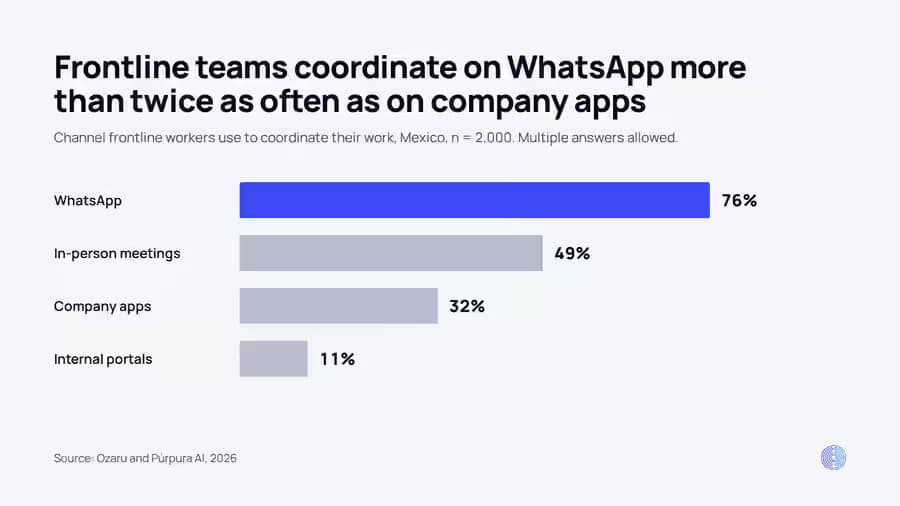
Ozaru and Púrpura AI surveyed 2,000 frontline workers between September 2025 and January 2026. 76% use WhatsApp as their main coordination tool. 49% still rely on in-person meetings, only 32% use company apps, and 11% use internal portals. And 60% prefer to do work tasks on their personal phone.
Companies show the same pattern. In the Meta and Boston Consulting Group study of 400 Mexican companies, more than 75% have already adopted messaging with their customers, and 70% are investing or plan to invest in AI for those channels.
WhatsApp didn't win because leadership chose it. It won because everyone already has it installed, and it works on the phone of whoever is on the job site, on the route, or in the warehouse.
The problem isn't WhatsApp: it's that the information doesn't exist for your systems
On WhatsApp, people report progress on the job site, confirm a delivery, ask for an invoice, and promise a payment. All of that is operational information, and it has three problems while it lives only in the chat:
- It depends on one person. Progress sits in the site supervisor's chat and the payment agreement in the sales rep's. To know anything, someone has to ask in the group.
- It never reaches the report. The ERP and the CRM never find out. The CEO decides based on what they were told, not on what happened.
- It leaves when the person leaves. In the same survey, six in 10 frontline workers are open to changing jobs soon. When they go, the history goes with their phone.
And there's a fourth cost that grows every month: AI can't use it either. An agent can't read what isn't in any system, as we explain in AI already connects to everything. Your operations, not yet.
Banning WhatsApp doesn't work
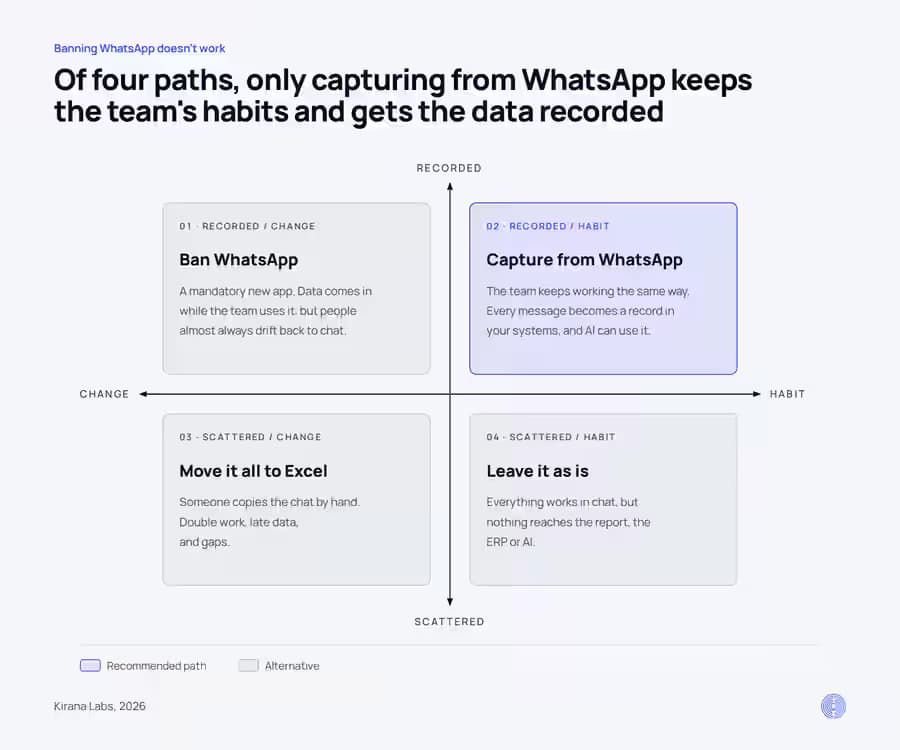
Asking the team to drop WhatsApp and log everything in a new app almost always ends in double work: people keep using the chat and the system stays half-filled. The numbers back this up, since only 32% use the apps the company already gave them.
What does work is letting the team keep working where it already works and capturing the information from there.
If you look at it as a decision, you have four paths, depending on whether your team changes tools and whether the information gets recorded.
How to turn WhatsApp messages into structured data
- Connect the right channel. Conversations with customers and suppliers connect through the official WhatsApp Business platform. For internal groups, you define what gets captured and with whose consent.
- Read everything, not just text. Voice notes get transcribed, photos get described, and data gets extracted from PDFs and invoices.
- Assign each message to where it belongs. Every piece of data gets linked to a project, a customer, or an account.
- Keep the source. Who said it, when, and in which chat, without editing the original message.
- Expose it with permissions. Your systems and your AI agents query that information based on what each role can see and do.
With that, a message stops being a conversation and becomes a record with an owner, a date, and a status.
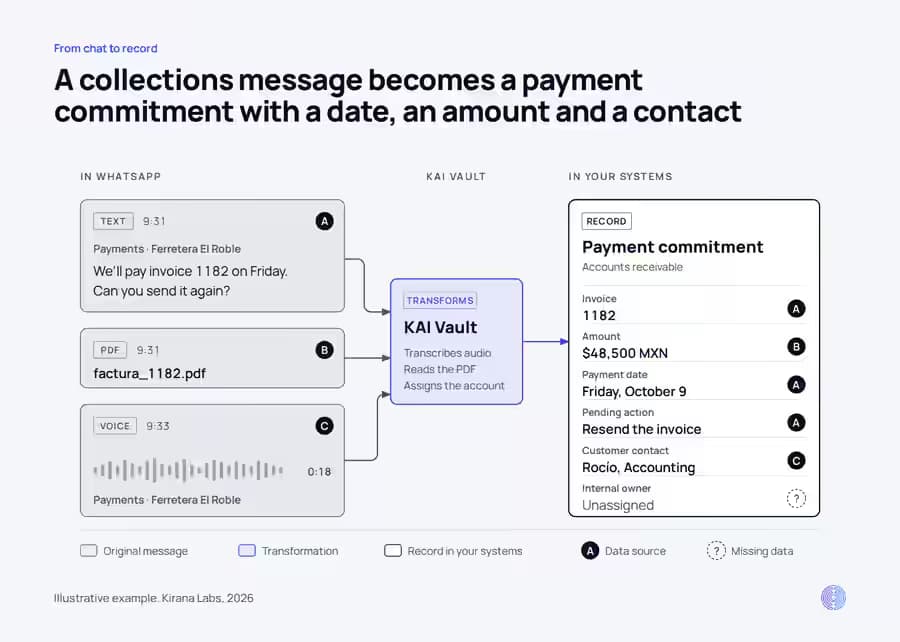
Here's what that looks like with a collections case: a text, a PDF, and a voice note end up as a single payment commitment, and every piece of data keeps track of which message it came from.
Three use cases
These examples are illustrative.
Project progress
The site supervisor sends a photo and writes that the second-floor slab has been poured. That gets logged as project progress, with the photo as evidence, and the weekly report for leadership builds itself. The same applies to installations, maintenance, or any field operation.
Customer service
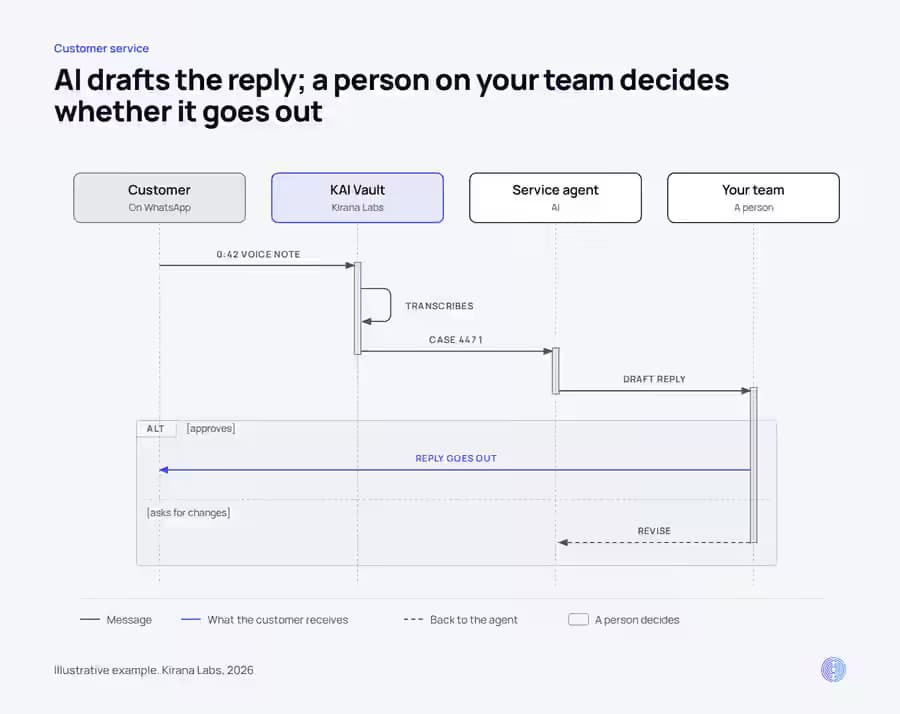
A customer sends a 42-second voice note: the order arrived incomplete and 12 boxes are missing. The audio gets transcribed, a case opens linked to the customer, and an agent drafts the reply with the replacement date. A person on your team approves it before it goes out.
Collections
This is the example from the diagram above: the customer writes that they'll pay invoice 1182 on Friday. That gets logged as a payment commitment with an amount and a date. On Friday a reminder goes out, and if the payment doesn't arrive, the person responsible gets an alert.
What to watch before connecting WhatsApp
- Use the official channel. Unofficial tools that read WhatsApp Web violate WhatsApp's terms and can cost you the number.
- Protect privacy. Update your privacy notice and ask for consent from the people involved. 40% of the workers surveyed see privacy risks in AI.
- Define permissions. Not everyone should see everything, and neither should AI.
- Keep a person in the loop. Anything that goes out to a customer gets approved by someone on your team.
How we do it at Kirana Labs
WhatsApp is one of the sources we connect with KAI Vault, the Kirana Labs layer that brings a company's digital information into one place, with permissions, and makes it available to AI. Before connecting anything, we put the data in order: which data wins and who owns each piece, as we explain in Before you automate: what has to be in order in your data.
Then come the agents. If you want to understand how they differ from traditional automation, read AI Agents vs Automation: What Actually Matters for Your Business.
Frequently asked questions
Can WhatsApp be integrated with an ERP or a CRM?
Yes. Conversations with customers and suppliers connect through the official WhatsApp Business platform, and each message becomes a record linked to a customer, an order, or an account inside your ERP or CRM.
Can AI read the voice notes, photos, and PDFs that come in on WhatsApp?
Yes. Voice notes get transcribed, photos get described, and PDFs yield data like invoice number, amount, and date. That's what lets an AI agent work with what happens on WhatsApp.
Do I have to stop using WhatsApp to get my data in order?
No. The team keeps working on WhatsApp and the information gets captured from there. Banning it usually ends in double work.
What should I watch before connecting WhatsApp to AI?
Use the official channel, update your privacy notice and ask for consent, define what each role can see, and have a person approve anything that goes out to a customer.
What is KAI Vault?
KAI Vault is the Kirana Labs layer that brings a company's digital information into one place, with permissions, including email and WhatsApp, and makes it available to AI.
About Kirana Labs
Kirana Labs is a nearshore software development and automation agency based in Monterrey that helps companies expand margin, founders get to revenue, and technical teams let go of production with confidence.
If you want to know how much of your operation lives on WhatsApp today and what you could do with that information, schedule a call.
Sources
- Ozaru and Púrpura AI, ¿Conectados o desconectados? Obstáculos y futuro de la fuerza laboral de primera línea en México, 2026, summary in El Cronista and Xataka México.
- Meta and Boston Consulting Group, Business Messaging: Pioneering Approaches for Mexican Businesses, 2024, summary in Expansión.